



Ningbo Beilun Ronghong Machinery Manufacturing Co., Ltd. is located in Ningbo, China, specializing in the manufacture of auxiliary equipment for plastic molding machines. Our products include hopper dryers, vacuum automatic loaders, temperature controllers, industrial chillers and central feeding systems.
Strong Production Ability
We own five production lines, with the factory covering an area of up to 10,000 square meters. There are also one hundred experienced workers in our team. Due to our excellent production setup and dedicated staff, our annual sales exceed 2.5 million US dollars.
Wide Range of Application
Our equipment finds extensive use in a wide variety of industries, such as electronics, household appliances, compact discs, building materials, packaging, beverages, and the medical industry.
Rich Experience
We have a wealth of 35 years of production experience in this field. During these years, we have continuously explored and innovated, and have been able to provide the best equipment and industrial solutions for plastic manufacturing.
Quality Control
We attach great importance to quality control. In the entire production process, from the incoming materials and components to the finished products, every step undergoes strict quality inspections. We ensure that every product that reaches the customer's hands meets the required standards.
What Is Mold Temperature Controller
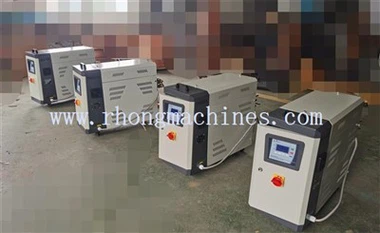
A mold temperature controller is an indispensable device that regulates and maintains mold temperatures at precise levels. This device works for both heating and cooling purposes and produces high-quality and precise products. Mostly used in plastic or metal molding, a mold temperature controller regulates the cold or hot temperature of a mold by circulating a heated or cooled fluid through the mold. Whether you' re manufacturing automotive components, consumer electronics, or aerospace parts, this method ensures consistent product quality and performance.




Benefits of Using Mold Temperature Controller
Improves Product Quality
It is possible to distribute uniform temperatures throughout a mold with the help of mold temperature controllers. It ensures a high product output with little to no defects like porosity and shrinkage.
Reduces Cycle Time
By controlling mold temperatures precisely, mold temperature controllers enable faster cooling. The accelerated cooling process makes your operations faster with shorter cycle times. It boosts your overall production efficiency of the aluminum die casting process, saving up money, energy, and other resources.
Enhances Energy Efficiency
When you use traditional aluminum die-casting methods, you might not have precise control over temperature. It might lead to excessive heating, which causes over-consumption of energy. Fortunately, mold temperature controllers offer you precise control over temperatures. Thus, there is no event of overheating, which prevents unnecessary energy wastage. Moreover, the mold temperature controller cuts down the preheating or after-cooling time. As a result, there is little to no idle time between two manufacturing processes, resulting in optimum energy and time efficiency.
Extends Mold Life
With fluctuations in temperature, molds get exposed to thermal stress. It can lead to cracks, wear and tear, and other types of damage. Mold temperature controllers eliminate the possibility of such damages as they are consistent at temperatures. It helps in preserving the structure of the mold. As a result, you save money on maintenance costs and mold replacement.
Part Dimensions And Quality
The temperature of the mold significantly influences the dimensions and shape of the final part. Improper temperature control can lead to variations in wall thickness, dimensional inconsistencies, and even part warping. Precise temperature control ensures uniform cooling and solidification, resulting in accurate part dimensions and superior quality.
Surface Appearance
Mold temperature is critical in achieving an attractive surface finish for the molded parts. Inconsistent cooling can cause surface defects like shrinkage, warpage, or uneven texture. By maintaining the optimum mold temperature, manufacturers can obtain smooth, glossy, and defect-free surfaces.
Types of Mold Temperature Controller
Water Temperature Controllers
Utilize water as the cooling medium, offering fast heat transfer and precise temperature control. Ideal for applications requiring rapid cooling and high accuracy.


Oil Temperature Controllers
Employ thermal oil for heat transfer, offering excellent thermal stability and uniform temperature distribution. Suitable for high-temperature moulding processes and materials with stringent temperature requirements.
Dual-zone Temperature Controllers
Feature multiple heating and cooling zones to accommodate complex moulds with different temperature requirements for various sections.


Portable Temperature Controllers
Compact and portable units designed for flexibility and mobility, allowing for easy integration into different moulding setups and production environments.
Application of Mold Temperature Controller
Temperature Controllers For Petroleum Applications
Refining: This process involves converting pure oil into finished products such as petrol, diesel and heating oil by passing it through a distillation tower and heating it to very high temperatures.
Catalytic cracking: This technique is used to convert heavier hydrocarbons into lighter petrochemicals by subjecting them to a temperature of around 500°C.
Steam injection for oil recovery: This technique is used to extract heavy, viscous oil from underground reservoirs by injecting high-temperature steam to thin the oil.
Temperature Controllers For Gas Applications
The installation of temperature controllers ensures that conditions are optimal for the extraction and processing of oil and gas. Fast and reliable temperature control increases efficiency in the various stages of fossil fuel processing.
Temperature Controller In The Paper Industry
The pulp and paper industry has a specific manufacturing process that requires accurate and stable temperature monitoring to ensure continuous production. Once produced, the pulp has to be converted into sheets for subsequent draining and drying, and this manufacturing process can be improved by temperature controllers.
Temperature Controller For Packaging Machines
Temperature is one of the major parameters to be monitored in the packaging sector, as it has a direct influence on raw materials. The packaging industry uses a wide range of industrial machines and tools, many of which employ methods involving heat in their operation.
In-Mold Cooling/Heating Channel
The mold cooling/heating pipe is made of seamless, rust-proof stainless steel. In addition, its design with the right size helps the coolant/heat to transmit in the mold at a stable speed.
Heat Conductor
The temperature conductor can be water or oil, depending on the type of machine you choose to use.
Temperature Control Unit
In addition, this unit uses a temperature sensor system to regulate and maintain the average mold temperature within the desired limits, regardless of production conditions.
Security System
Moreover, this mold temperature controller includes devices such as automatic disconnection of the power supply without fuse, automatic reduction of load pressure, abnormal alarm bells, thermal protection, reverse transfer protection, display lights, etc.
How to Maintain Mold Temperature Controller
Regular Cleaning
Proper cleaning after each production run prevents residue buildup, which can affect the mold's performance and lead to defects in the moulded parts. Use appropriate cleaning agents and tools to remove any plastic residue, rust, or other contaminants.
Inspection for Wear and Tear
Conduct regular inspections to identify wear and tear on the mold components such as ejector pins, guide pins, and bushings. Replace parts that show signs of damage to prevent more extensive issues that could halt production.
Lubrication
Lubricate moving parts and components to reduce friction and wear. Use high-quality lubricants recommended by the mold manufacturer and apply them according to the specified intervals.
Temperature Control
Maintain optimal temperature control during the molding process to prevent thermal stress on the mold. Sudden temperature fluctuations can cause deformation or cracking, leading to mold damage and poor product quality.
Storage and Handling
When not in use, store molds in a clean, dry environment to prevent rust and contamination. Use protective covers or coatings if necessary to maintain the mold's condition. Handle molds with care to avoid any impact or mishandling that can result in damage.
Maintenance Records
Provide comprehensive training to personnel involved in mold maintenance to ensure they understand proper procedures and techniques. Continuous education on new maintenance practices and technologies is also beneficial for optimizing mold performance.
How to Choose Mold Temperature Controller


Heat Conducting Medium: Water or Oil?
Heat-conducting mediums can be either water or oil; as discussed above, both systems have unique benefits. For example, water heat conducting mediums allow precise control over the exact temperature, but the temperature can only reach up to 180℃. Whereas, if you use a system with oil as the heat conducting medium, you can reach much higher temperatures, up to 350℃, which is more suitable for product manufacturing that uses compounds with higher melting points.
Cooling Mode
Internal and external cooling systems can be used in temperature control units. It will depend on the cooling capacity you need for production. Our standard products feature internal temperature controls, which is a fast, and efficient cooling method. This keeps the temperature consistent throughout the process and limits temperature variations.
Control System
The control system can be either analogue or digital. With digital controllers, you can use an intuitive digital screen to set your temperature and turn the controller on or off; this is the most straightforward method. Both systems are precise. And yet if a customer chooses a PLC system, it is easier to connect and communicate with other machines and add additional sensors for data collection.
Production Environment
Production environments can impact the functionality of temperature control units. For example, analogue control systems are suitable for harsh production environments as they can withstand significant electronic noise without disrupting the process. This is due to the analogue controls that do not rely on an electronic screen. On the other hand, whether production is conducted in a clean room or not also matters. Because oil temperature controllers operate on an oil vapor. If there is oil leakage, it can be challenging to clean the environment. Therefore, an oil temperature controller model is generally not recommended for a Cleanroom environment.
Consider Size And Compatibility
The temperature controller must be sized to match the molding operation's scale and the mold being used. If you use larger molds or produce high volumes, you need a temperature controller with excellent heating and cooling capabilities. Conversely, smaller molds or low-volume production may require a more compact temperature controller.
Temperature Controller Advanced Features And Functions
Modern mold temperature controllers often have advanced features and functions to increase performance and productivity, such as precision temperature control, advanced temperature controllers to provide precise temperature regulation with minimal deviation from the set point, sophisticated algorithms, and sensor technology to maintain temperatures within tight tolerances and ensure consistent product quality and process repeatability.
Troubleshooting of Mold Temperature Controller
Fouling Of Internal Water Lines In The Mold
Suspended or dissolved solids can build up on channel surfaces, reducing fluid flow and limiting heat transfer between the steel and cooling water.
Fouling Of Lines In Cooling Equipment
The same types of issues can apply to the heat exchangers and piping in chillers and TCUs. Filters can be used to remove many suspended solids, but dissolved solids like lime need to be addressed by a water-quality specialist familiar with the water in your region. In a closed-loop system, periodic checking of water chemistry and conductivity can also warn when dissolved-solids content is reaching problematic levels.
Cooling-Tower Water Contamination
A tower can become contaminated by all sorts of airborne debris (tree seeds, leaves, etc.), as well as algae. A full-flow strainer on the tower outlet can eliminate a lot of the problems, and a properly sized pump tank will allow solids to settle out of the water before it is pumped into the heat-transfer system. Here, too, it is important to watch dissolved solids. Towers cool by evaporation and solids can build up, so it's a good idea to regularly replace a percentage of the water.
Environmental Issues
Ambient conditions can also affect the way an injection mold and associated heat-transfer equipment perform. Hot, humid summer weather can burden your heat-transfer system by adding to the heat load. In hot weather, heat transfer to ambient air is reduced and thus more heat needs to be removed by the system. In addition, outdoor cooling-system equipment efficiencies and capacities may be negatively affected by higher ambient temperatures and humidity.
Refrigerant Leaks
A gradual loss of refrigerant pressure due to a slow leak will degrade chiller performance. Not only is it costly to repair the leak and replace the refrigerant, but many cooling gases (especially Freon used in older systems) pose an environmental hazard.
Several Methods Are Employed For Mould Temperature Control
Fluid Temperature Control
This widely used method offers sufficient control accuracy for most applications. However, temperature fluctuations within the mould can occur due to unmeasured thermal factors, such as variations in the injection cycle, speed, melt temperature, and ambient temperature.
Direct Mold Temperature Control
This method involves installing a temperature sensor inside the mould, delivering higher control accuracy. Key features include consistent temperature alignment between the controller and mould, along with direct measurement and compensation of thermal factors. It typically provides better mould temperature stability and production process repeatability.
Combined Control
A hybrid approach that simultaneously regulates fluid and mould temperatures. Proper sensor placement within the mould, considering cooling channel configuration and part quality influence, is essential for effective joint control. Integration of one or more mould temperature controllers with the injection moulding machine controller is accomplished through digital interfaces for enhanced operability, reliability, and interference resistance. Automated control features to enable seamless communication between the control unit and injection moulding machine, optimizing cycle times and ensuring injection part quality stability.
Setting Up and Operating Mold Temperature Controllers
Understand the plastic being used and its flow temperature. Set the barrel temperature accordingly, considering both plasticization and flow requirements. Adjust temperatures based on the specific characteristics of the plastic, such as molecular weight and distribution.
Ensure the nozzle temperature is slightly lower than the maximum barrel temperature to prevent the “flowing phenomenon” of melt in the straight-through nozzle. Avoid setting the nozzle temperature too low to prevent early condensation of the melt, which can block the nozzle or affect product performance.
Mold temperature greatly influences the intrinsic properties and apparent quality of the product. Consider factors such as the presence of crystallinity in the plastic, the size and structure of the product, performance requirements, and other molding process conditions. Set the mold temperature accordingly to achieve the desired quality and properties in the final product.
Continuously monitor the temperature settings during the molding process and make adjustments as needed. Fine-tune the temperature controllers based on feedback from the molding process, ensuring optimal plasticization, flow, and cooling throughout the production cycle.
Our Factory


Frequently Asked Questions
Q: How to control mold temperature?
Q: What is the best mold temperature?
Q: What is a mould temperature controller?
Q: What temperature is mould casting?
Q: What is the purpose of the temperature controller?
Q: How to measure mold temperature controllers?
Use contact thermometers to measure the mold temperature. You can place them directly on the mold surface.
If you want to measure the temperature of the mold at various touchpoints, use thermocouples or infrared thermometers. Remember to keep them consistent throughout the process to get accurate results.
If you need to measure the temperatures at a specific depth of the mold, insertion thermometers are an ideal choice.
Q: How does a mold temperature controller unit work?
Q: What is the working principle of mold temperature controller?
Q: What is the temperature control in injection molding?
Q: How does a temperature controller work?
Q: What is the application of a temperature controller?
Q: What is the use of mold temperature controller?
Q: What is the temperature moulding process?
Q: What is the function of the mould temperature controller?
Q: How does mould temperature affect injection moulding?
Q: What is the mould temperature controller used for?
Ningbo Beilun Rhong Machinery Manufacturing Co.,Ltd. is one of the most professional mold temperature controller manufacturers and suppliers in China, specialized in providing the best customized service. We warmly welcome you to wholesale high quality mold temperature controller made in China here from our factory. For price consultation, contact us.
120 degree Mold Temperature Controller, consistent heating performance, heavy duty cooling machinery